7 High School Classes That All Aspiring Marine Biologists Should Take

From swimming with marine life to exploring marine environments around the globe, a career in marine biology can be an absolute dream.
But it takes a lot of hard work to achieve, with most jobs requiring multiple advanced degrees and real-world experience. Luckily, you can start laying the groundwork for your future as a marine biologist as early as high school.
Since math and science are the bedrock of marine biology, you’ll want to focus your high school studies on these two areas as much as possible. Marine biology programs look for students with strong backgrounds in both fields, so a math-and-science-heavy transcript will help you stand out from other applicants and increase your chances of getting into top-tier programs. Plus, it’ll also show foresight, planning, and dedication to the field.
Looking at the prerequisites for top marine biology programs around the country, here’s a list of seven classes that all high school students should take if they plan to study marine biology.
What high school courses are needed for marine biology programs?
While entry requirements may vary by program, most marine biology programs either require or prefer to see the following classes on your high school transcript. If you want to stand out from other applicants and increase your odds of being accepted to your dream program, here are some essential classes you should take during high school.
1. Biology
Biology is a standard course across nearly all high school curriculums, but it’s a non-negotiable for anyone looking to become a marine biologist. In this course, you’ll learn the basic building blocks of biology like cell biology, molecular biology, ecology, evolution, genetics, and much more. You’ll also take your first forays into the fundamentals of science, from understanding scientific inquiry to creating and conducting labs, collecting data, writing reports, and summarizing results.
Understanding the basics of biology and learning the proper procedures for how to be a scientist give you the foundation you need to study marine ecosystems.
2. Mathematics
Since marine biology requires things like graphing and data analysis, you’ll also need to be good at math. College programs will look for experience in algebra and geometry in particular, as you’ll need to be able to make graphs, balance equations, create measurements, and use mathematical models. Depending on what area of marine biology you choose to focus on, these mathematical skills have all sorts of applications from measuring length or depth to calculating the population size of a certain species of marine creatures.
3. Physics
As the study of matter and how it moves and behaves, physics and marine biology go hand-in-hand. By having a physics class on your high school transcript, you’ll show potential marine biology programs that you understand basic scientific laws and concepts like gravity, motion, light and sound waves, thermodynamics, and electromagnetism.
4. Precalculus
Precalculus covers all sorts of essential topics like graphing, vectors, slopes of curves, rates of change, and other types of mathematical modeling that you’re bound to encounter working in marine biology. While many undergraduate marine biology programs include precalculus and calculus courses, you can get ahead of the curve by taking them in high school. Some programs even have Precalculus 1 (and sometimes Precalculus 2) as prerequisites, so it’s a good idea to dive into this advanced field of mathematics as soon as possible.
5. Statistics
Statistics is another course that marine biology programs will want to see on your high school transcript. Covering data analysis and probability, statistics teaches you how to collect, analyze, and interpret data, which are skills you’ll use for research areas like studying the population growth or decline of marine animals.
6. Computer science
Computer science is used throughout marine biology for everything from ocean modeling to geographic information systems, so it’s a good idea to have a computer science course under your belt. You’ll walk away having learned how to read and write basic computer languages, use different software programs and platforms, code, and much more.
7. Chemistry
Do you want to understand how the chemical components of the ocean will be affected by climate change or research how different species have evolved to thrive in marine environments? Then you’ll need to sign up for some chemistry classes. Before diving into the rich world of marine chemistry, high school chemistry courses teach you the fundamentals of this natural sciences branch including the periodic table, chemical processes and reactions, bonding, and atomic structure.
Other pre-college marine biology courses and programs
Along with high school classes and courses, there are other things you can do to prepare yourself.
AP classes
You can go the extra mile by taking advanced placement courses in the above topics or on specific subjects like Environmental Science. Even if some credits can’t be applied to your major, you’ll still have the experience and knowledge.
Private pre-college programs
If you’re already decided on studying marine biology or marine science in college, then a private pre-college prep program might be for you. These immersive courses range in duration from a couple of weeks to a couple of months and often include field work as well as classroom study.
- Cornell University Shoals Marine Laboratory: Programs for High School Students
- Brown Research Methods in Marine Science
- Stanford Topics in Bioscience (Not specific to marine biology. Remote learning)
- UC San Diego Marine Sciences
- UConn pre-college Marine Biology
- Stony Brook Southampton (NY), Oceanography
Sailing programs
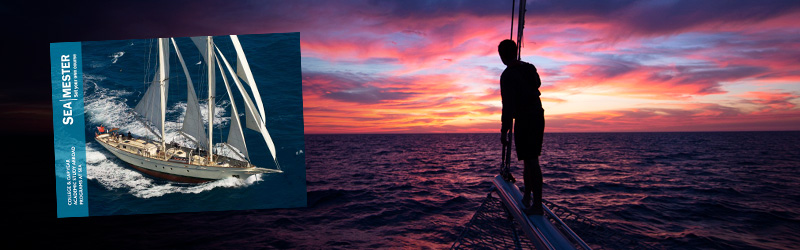
If you want to show programs that you’re serious about becoming a marine biologist (or want to gain some real-world experience before committing), a great way to get your feet wet (literally) is by embarking on a sailing gap year program. Taken during a gap year or summer break, educational sailing programs like Sea|mester let you take your studies on the high seas. Take accredited courses in topics like oceanography and nautical science, gain practical experience in related skills like sailing, navigation, and scuba diving, and create unforgettable memories with new friends.
About The Author – Kris Stevenson
Kris was born in Rotterdam, Holland, and spent most of his formative years growing up in the Middle East and England. He graduated from the University of Southampton, United Kingdom, with a Masters degree in Oceanography.
Following a strong family connection to the sea, Kris was naturally inclined towards a life revolving around the Oceans. Kris first joined Global Expeditions Group in the summer of 2008, working with ActionQuest in the British Virgin Islands as a marine biology instructor before coming on board full time as part of the Sea|mester Operational team in 2009